At a glance
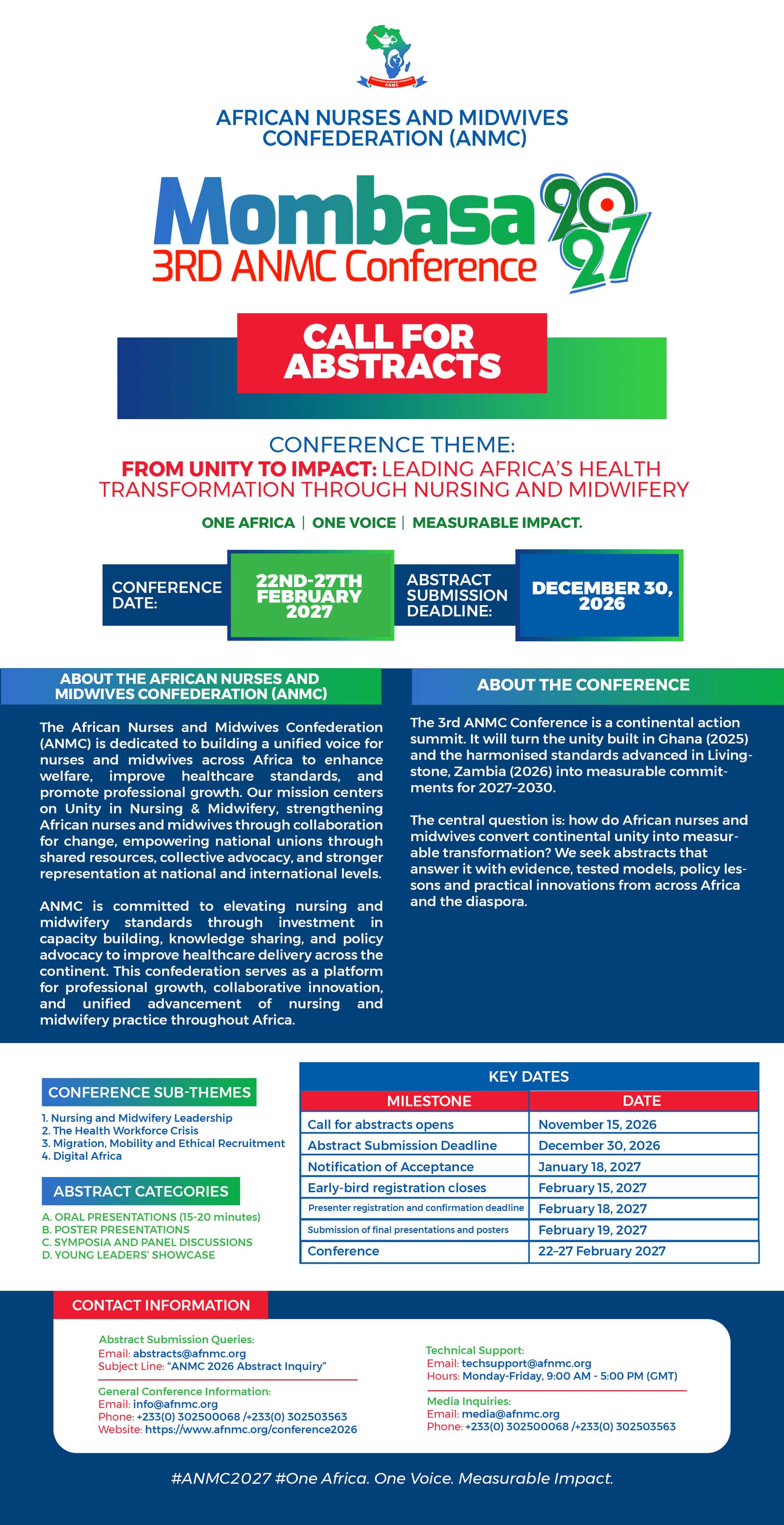
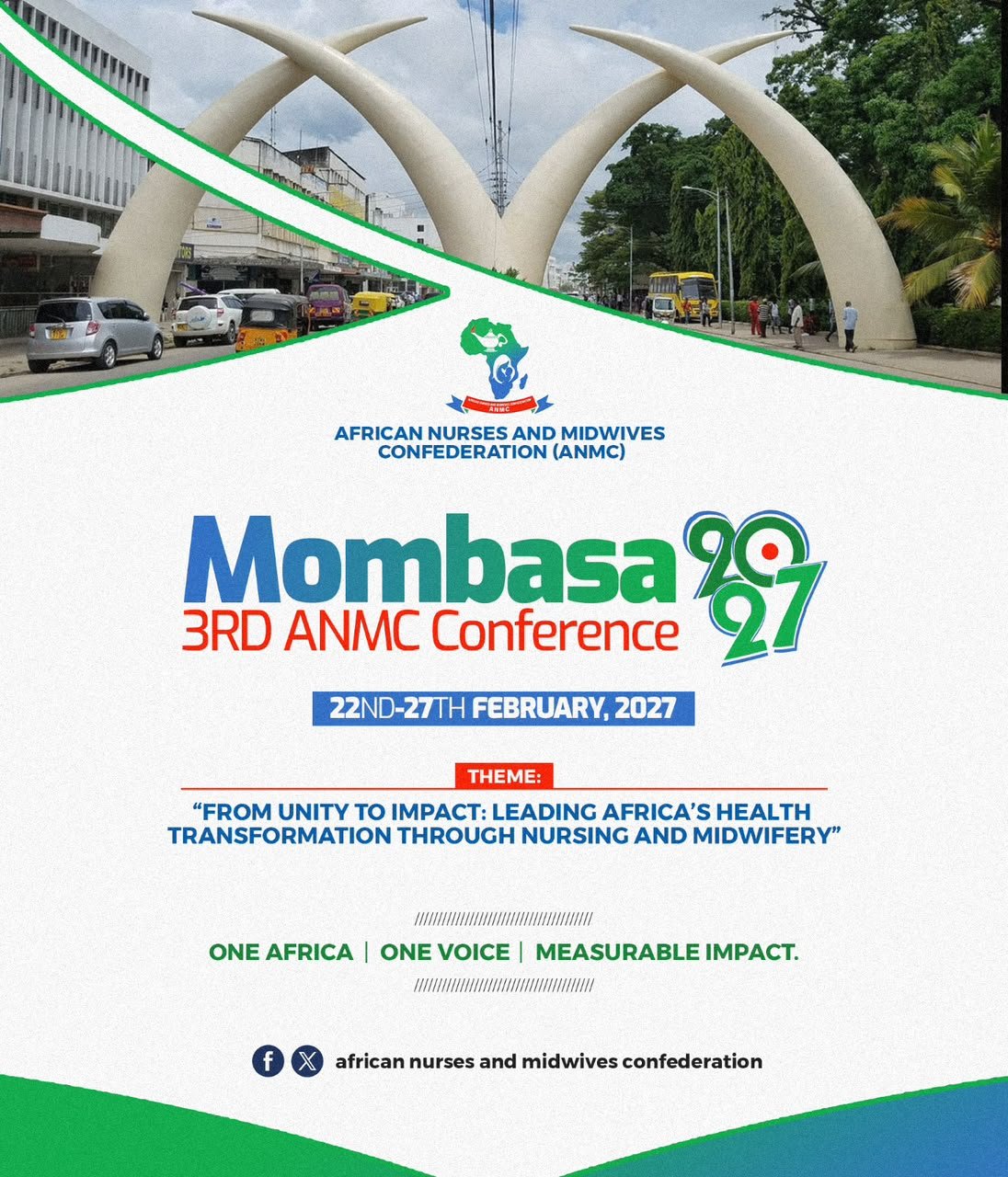
Theme:From Unity to Impact: Leading Africa’s Health Transformation through Nursing and Midwifery
Tagline:One Africa. One Voice. Measurable Impact.
| Item | Details |
|---|---|
| Dates | 22–27 February 2027 |
| Host country | Kenya, Mombasa (venue to be announced) |
| Organiser | African Nurses and Midwives Confederation (ANMC) |
| Format | Scientific Conference, Leadership Forum, Policy Dialogue, Partnership Forum and ANMC General Assembly |
| Expected participants | 250–300 |
The African Nurses and Midwives Confederation (ANMC) invites nurses, midwives, researchers, educators, regulators, policymakers, trade union and association leaders, students and partners to submit abstracts for oral, poster and panel presentations at the 3rd ANMC Conference in Ethiopia.
About the Conference
The 3rd ANMC Conference is a continental action summit. It will turn the unity built in Ghana (2025) and the harmonised standards advanced in Livingstone, Zambia (2026) into measurable commitments for 2027–2030.
The central question is: how do African nurses and midwives convert continental unity into measurable transformation? We seek abstracts that answer it with evidence, tested models, policy lessons and practical innovations from across Africa and the diaspora.
Accepted work will feed directly into the conference outputs, including:
- The ANMC Continental Action Agenda 2027–2030
- An African Nursing and Midwifery Workforce Advocacy Framework
- An Ethical Recruitment and Health Workforce Mobility Position Paper
- A Digital and Artificial Intelligence Readiness Framework
- An ANMC Leadership Development Framework
- A Continental Research and Innovation Collaboration Platform
Presenters join nursing, midwifery, health, labour, regulatory and development leaders from across the continent, and their evidence can shape continental positions adopted at the conference.
Sub-themes and Suggested Topics
Abstracts must be submitted under one of the nine sub-themes below. The topics listed are guides, not limits.
Sub-theme 1 Nursing and Midwifery Leadership: From Representation to Real Influence
- Nurses and midwives in national and continental health governance
- Political leadership, policy influence and representation on boards and commissions
- Leadership development for emerging nurse and midwife leaders
- Women’s leadership and gender equity in health leadership
- Trade unions and professional associations as instruments of policy influence
Sub-theme 2 The Health Workforce Crisis: Investing, Retaining and Protecting Africa’s Nurses and Midwives
- Workforce shortages, unemployment and labour market dynamics
- Delayed recruitment and deployment; workforce planning and forecasting
- Retention strategies and deployment to rural and underserved areas
- Occupational safety, workplace violence, mental health and wellbeing
- Fair remuneration, social protection, pensions and safe staffing
- Public investment in the nursing and midwifery workforce
Sub-theme 3 Migration, Mobility and Ethical Recruitment: Building a Fair Global Health Workforce
- Ethical international recruitment and bilateral labour agreements
- Compensation, benefit-sharing and circular or managed mobility
- Retention in source countries and diaspora engagement
- Brain drain versus brain circulation; decent work and forced migration
- Regional mobility, mutual recognition and protection of migrant nurses and midwives
- Data systems for tracking health workforce mobility
Sub-theme 4 Digital Africa: Artificial Intelligence, Innovation and the Future of Nursing and Midwifery
- Artificial intelligence in nursing and midwifery practice and education
- Digital literacy, future competencies and technology-enabled workforce management
- Telehealth, digital documentation and interoperability
- Simulation and virtual learning
- Data protection, digital ethics and bridging the digital divide
- Innovations developed in Africa for African health systems
Sub-theme 5 From Primary Health Care to Universal Health Coverage: Nurses and Midwives at the Centre of Healthcare Delivery
- Nurse-led and midwife-led models of care
- Primary healthcare transformation and Universal Health Coverage
- Community health, prevention, non-communicable diseases and mental health
- Ageing populations, sexual and reproductive health
- Women’s, maternal, newborn, child and adolescent health
- Advanced practice and expanded scope of practice
Sub-theme 6 Climate, Conflict and Crisis: Preparing the Nursing and Midwifery Workforce for a Changing Africa
- Climate change and health; disaster and pandemic preparedness
- Humanitarian and conflict-zone nursing and midwifery
- Emergency and critical care capacity
- Occupational protection of health workers in crises
- Displacement and refugee health; resilient and adaptive health systems
Sub-theme 7 Education, Regulation and Harmonisation: Preparing the African Nurse and Midwife of 2030
- Harmonisation of education and competency frameworks
- Mutual recognition of qualifications and cross-border practice
- Continuing professional development, faculty development and clinical mentorship
- Advanced and specialist practice
- Regulatory collaboration and quality assurance in education
Sub-theme 8 Decent Work, Gender and Social Justice: Protecting Those Who Care
- Decent work, gender pay gaps and workplace discrimination
- Violence and harassment; implementation of ILO Convention 190
- Collective bargaining, social dialogue and social protection
- Work-life balance, career progression and leadership opportunities for women
Sub-theme 9 African Research and Innovation: Generating Evidence for African Solutions
- Nurse-led and midwife-led research and implementation science
- Translating research into policy; research funding
- Multi-country studies and research collaboration across Africa
- Indigenous knowledge and culturally appropriate care
- Innovation hubs and intellectual property
No sub-theme or topic matches your search.
Presentation Formats and Abstract Categories
Authors indicate a preferred format; the Scientific Committee makes the final allocation.
| Format | Description | Time |
|---|---|---|
| Oral presentation | Individual presentation in a concurrent sub-theme session | 10 minutes + 5 minutes Q&A |
| Poster presentation | Printed poster displayed throughout the conference, with a scheduled viewing session | Poster session |
| Panel / symposium | Three to four speakers from at least two countries or institutions on one sub-theme | 60–90 minutes |
| Young Leaders’ Showcase | Rapid presentation by students and early-career nurses and midwives (35 years and under) | 5 minutes |
Abstracts may fall into any of these categories:
- Original research— quantitative, qualitative or mixed-methods studies
- Practice innovation and quality improvement— nurse- or midwife-led models, projects and service improvements with results
- Policy, advocacy and leadership— policy analysis, advocacy campaigns, union and association experience
- Education and regulation— curriculum, competency, CPD and regulatory initiatives
- Case studies and lessons learned— country or institutional experiences with transferable lessons
Selected abstracts may be invited to the Special Forums, including the Regulators Forum, Young Nurse/Midwife Leaders’ Forum and Research-to-Policy Forum.
Submission Guidelines
All abstracts must be in English, not exceed 300 words (excluding title, authors and affiliations), and be submitted through the official portal: abstracts@afnmc.org.
General requirements
- Title: maximum 20 words, in sentence case.
- Authors: full names, affiliations, country and email of each author; underline the presenting author.
- Sub-theme: select one of the nine sub-themes.
- Preferred format: oral, poster, panel or Young Leaders’ Showcase.
- Keywords: three to five.
- No tables, figures, images or references in the abstract body.
- Abbreviations spelled out at first use.
- Each presenting author may submit a maximum of two abstracts as first author.
Abstract structure
Research abstracts: Background, Aim/Objectives, Methods, Results, Conclusion and Implications for Policy or Practice.
Practice, policy and case study abstracts: Background/Problem, Intervention or Approach, Outcomes/Results, Lessons Learned, Recommendations.
Panel proposals: a 300-word overview of the panel’s aim and relevance to the theme, plus a title and 150-word summary for each speaker, with the chair named.
Every abstract should state how the work contributes to measurable impact on health outcomes, workforce conditions or policy — the core of the conference theme.
Ethics and originality
- Research involving human participants must state ethical approval.
- Work must be original. Previously presented work is accepted only where new findings or analysis are included.
- Authors confirm that all co-authors have approved the submission.
Abstract word check
Paste your title and abstract to check them against the word limits before you submit. Nothing you type is sent anywhere.
Review Process and Selection Criteria
Each abstract is blind-reviewed by at least two members of the ANMC Scientific Committee and scored on the criteria below.
| Criterion | Weight |
|---|---|
| Relevance to the conference theme and chosen sub-theme |
20%
|
| Originality and contribution to knowledge or practice |
20%
|
| Methodological soundness or quality of the approach |
20%
|
| Clarity and structure of the abstract |
15%
|
| Demonstrated or potential measurable impact on policy, practice or workforce |
25%
|
The committee aims for a balanced programme across countries, regions, languages of practice, career stages and sub-themes. Its decisions are final. Accepted abstracts will be published in the conference proceedings, subject to the presenting author registering by the deadline.
Publication of Conference Proceedings
The conference proceedings will be published by the Ghana Journal of Nursing and Midwifery (GJNMID), owned and operated by the Ghana Registered Nurses and Midwives Association (GRNMA), Accra, Ghana.
Only abstracts that are accepted and presented at the conference will be included in the proceedings.
Key Dates
| Milestone | Date | Status |
|---|---|---|
| Call for abstracts opens | Passed | |
| Abstract submission deadline | Next | |
| Notification of acceptance | Upcoming | |
| Early-bird registration closes | Upcoming | |
| Presenter registration and confirmation deadline | Upcoming | |
| Submission of final presentations and posters | Upcoming | |
| Conference | Upcoming |
Who Should Submit
We welcome abstracts from:
- Nurses and midwives in clinical practice, community health and humanitarian settings
- Nursing and midwifery associations and trade unions
- Researchers and educators from universities and training institutions
- Nursing and midwifery regulatory councils and Chief Nursing and Midwifery Officers
- Officials of Ministries of Health, Labour, Finance and Foreign Affairs, and health employers
- Students and young professionals
- International organisations, development partners, civil society and technology and innovation organisations
Submissions from young and first-time presenters, and from fragile and underrepresented settings, are strongly encouraged.
Registration and Presentation
- At least one author of each accepted abstract must register and attend in person to present.
- Abstracts whose presenting author has not registered by the presenter deadline will be withdrawn from the programme and the conference proceedings.
- Acceptance does not include funding for travel, accommodation or registration unless stated in the acceptance letter.
- Poster dimensions and slide templates will be sent with notification of acceptance.
Contact
ANMC Scientific Committee — 3rd ANMC Conference 2027
- Email:
- abstracts@afnmc.org
- Website:
- afnmc.org
One Africa. One Voice. Measurable Impact.